

As tactical satellite communications continue to evolve, the conversation is shifting beyond antenna performance alone. Today’s military and government users increasingly require complete, integrated communications architectures that simplify deployment, reduce complexity, and improve operational readiness.
In a featured article published by SatNews, Lite Coms explores how modern tactical VSAT systems are moving away from traditional “parts bin” deployments—where antennas, modems, and control software are sourced separately—and toward unified platforms designed to operate as a single system.
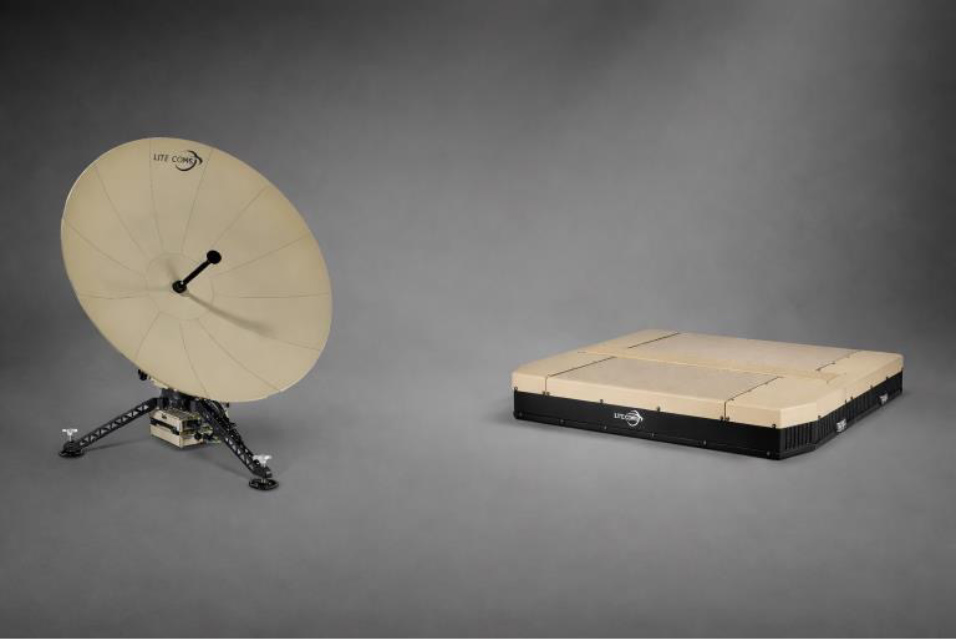
| Feature | Parabolic VSAT | ESA VSAT |
| Signal acquisition | Motorized auto-acquire | Electronic beam steering |
| Deployment time | Minutes | Near-instant |
| Mobility | Quick halt (COTP) | Full COTM capable |
| Constellation support | GEO, MEO, HEO | LEO, GEO, MEO |
| Throughput | High | Moderate to high |
| Best suited for | Expeditionary backhaul, fixed-site C2 | Tactical vehicles, mobile command, rapid deployment |
The article examines several key trends shaping the future of tactical SATCOM, including:
- Why integrated system architectures are replacing standalone hardware approaches.
- The mission-dependent roles of parabolic and electronically steerable (ESA) terminals.
- How Tactical Modem Assemblies (TMAs) reduce deployment time, cabling, and potential points of failure.
- The benefits of unified operator interfaces that simplify training, configuration, and system management.
- Why future defense procurements are increasingly evaluating complete communications architectures rather than individual components.
As defense missions become more dynamic, operators need communications solutions that are faster to deploy, easier to manage, and built to perform reliably in demanding environments. Integration is becoming a key differentiator in meeting those requirements.
Read the full SatNews article to explore how integrated tactical SATCOM architectures are shaping the future of deployable communications.