
How to Select a Reliable COTM SATCOM System for Tactical Vehicles

What COTM means for tactical vehicles and what this guide helps you decide
Communications-on-the-move (COTM) is satellite communication that holds a link while the platform is in motion. ThinKom’s explainer on COTM describes the mechanism plainly: a stabilized or tracking antenna keeps the beam locked on the satellite as the vehicle pitches, turns, and accelerates. That distinguishes it from communications-at-the-halt, where the crew stops, deploys, and acquires — a workflow that is fine for a static command post and unacceptable for a maneuvering convoy. The distinction drives terminal class before any specification sheet matters.
The selection goal for a remote tactical vehicle mission is narrow: pick a terminal that survives the mission duration, fits the platform’s roof space, power budget, and profile, and stays up when dust, vibration, thermal load, and RF interference arrive together.
Five factors decide that: mobility profile, antenna tracking behavior, ruggedization against real failure modes, security and waveform constraints, and integration with vehicle power and network systems — including Ka- and Ku-band service availability across your operating area.
This is a buying method for tactical vehicle fleets, not a product catalog.
Selection criteria for vehicle-mounted COTM systems
Mobility. Define the link profile first: continuous tracking during convoy movement, short-halt operation, or both. A terminal that reacquires in seconds after a blockage matters more than peak throughput on a route with overpasses, terrain masking, and tree lines.
Antenna performance. Match band and orbit support to the mission. X and military Ka align with Wideband Global SATCOM access; Ku supports commercial capacity; low-latency LEO suits streaming video and mission command traffic.
Ruggedization. Ask for test evidence against the standards the community already uses — MIL-STD-810 for shock and vibration, MIL-STD-461 for electromagnetic interference, MIL-STD-464 for electromagnetic compatibility — plus dust, thermal, and sealing behavior on a moving hull.
Security and availability. Confirm protected network compatibility, encryption handling, and automatic failover. LTE/5G fallback keeps traffic moving when the satellite link degrades.
Vehicle integration. Verify input voltage tolerance, transient protection, cable runs, mounting footprint, and onboard routing. Finally, check whether operators can monitor and troubleshoot several terminals from one control interface rather than terminal by terminal.
How to choose between fly-away terminals and flat-panel COTM systems
The choice comes down to one question: does the mission tolerate a halt to establish the link?
Choose a fly-away auto-acquire terminal when the unit stops to operate — company command posts, forward logistics nodes, extended-duration sites. A parabolic aperture buys link margin and higher throughput on X, Ku, and Ka, and tool-free setup keeps the operator burden low. The tradeoff is real — nothing is passing traffic while the vehicle is rolling, and stowed volume competes with mission load.
Choose a flat-panel system when the route matters more than the halt: convoy movement, mounted patrols, armored platforms with height and signature limits. Low-profile enclosures integrate into a tactical vehicle roofline and hold the link while moving. The cost is integration planning — power draw, mounting loads, cable routing, and RF clearance must be resolved before installation, not during it.
Mixed fleets usually need both: flat panels on the maneuver elements, fly-away kits at the nodes that stop.
Failure modes in dust, vibration, heat, and RF interference
Most field failures trace to four causes. Fine dust works into positioner gears, connector shells, and cooling paths, degrading tracking accuracy before it causes an outright fault. Vibration and shock loosen mounts, fatigue coaxial runs at strain points, and slowly walk an antenna off alignment. Thermal stress shows up as heat soak in sealed enclosures during static overwatch and as slow acquisition on cold starts. Finally, co-site emitters and unstable vehicle power produce intermittent link loss that looks like a satellite problem but is not.
Controls are straightforward: specify shock, vibration, and environmental qualification to MIL-STD-810 and electromagnetic interference performance to MIL-STD-461; use sealed, ruggedized enclosures and low-profile flat-panel terminals with fewer exposed moving parts; torque-check mounts on a schedule; condition DC power; and watch signal quality centrally.
What Lite Coms systems add for multi-orbit tactical vehicle deployments
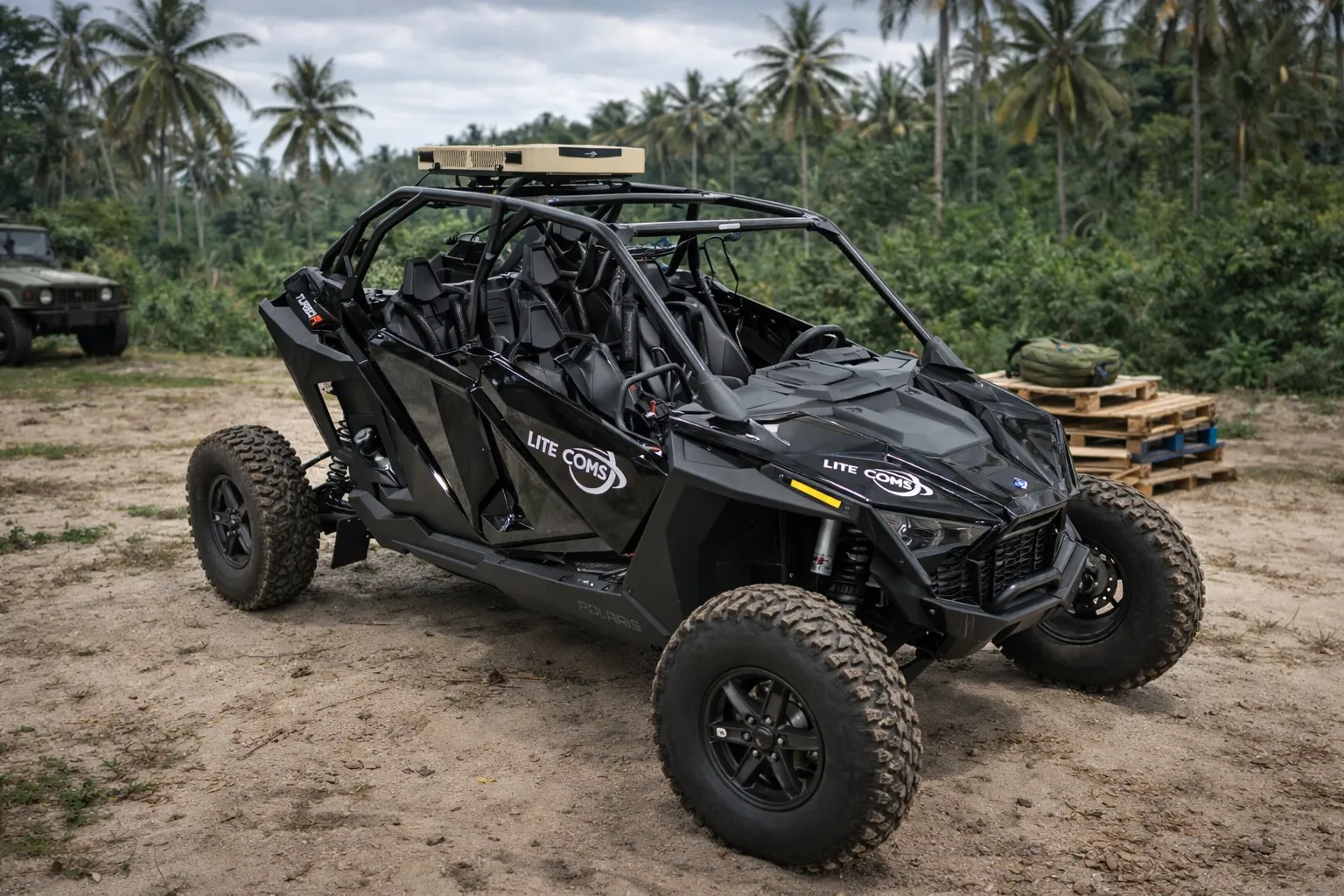
Lite Coms documentation describes a constellation-agnostic family: terminals that work across LEO, GEO, and MEO networks with LTE/5G failover, so a convoy losing one path drops to another instead of going dark. That multi-orbit spread is the practical answer to the selection question most officers face — matching mission duration and mobility to available capacity rather than to a single band plan.
The fly-away terminals are built around tool-free setup, auto-acquire, and X, Ku, and Ka band operation for halted command posts. Flat-panel units handle on-the-move work, with low-profile vehicular integration, LEO connectivity, and ruggedized sealed enclosures for dust, vibration, and thermal stress. Tactical Modem Assemblies fold modem and transport functions into one unit, cutting hardware footprint inside crowded crew compartments, while the Lite Link GUI centralizes monitoring and troubleshooting across multiple systems.
The tradeoff: integration narrows the box count, but power budgets, mounting, and network interfaces still need vehicle-specific engineering before fielding.
FAQ: common questions from operators and integrators
Does every tactical vehicle need COTM? No. Comms-on-the-move earns its cost when the mission must hold a link while moving. Halt-and-communicate profiles are often served better by a fly-away terminal with auto-acquire and tool-free setup.
X, Ku, Ka, or multi-orbit? Match band to the networks you are actually authorized on — X and military Ka for WGS access, Ku for commercial capacity — and add LEO or LTE/5G failover for long-duration missions in contested spectrum.
What should procurement demand? Written standards references (MIL-STD-461, MIL-STD-810 and similar), ingress ratings, vehicle power draw, mounting footprint, and integration data — not adjectives.
Reducing operator burden? Ask vendors to demonstrate acquisition time and remote monitoring across multiple terminals. Lite Coms can help with that.