
How to Select a Reliable COTM SATCOM System for Tactical Vehicles

How to Select a Reliable COTM SATCOM System for Tactical Vehicles

d6277de7-b88a-40e7-9f56-47eb4e7eec8b.png

What COTM means for tactical vehicles and what this guide helps you decide

Communications-on-the-move (COTM) is satellite communication that holds a link while the platform is in motion. ThinKom’s explainer on COTM describes the mechanism plainly: a stabilized or tracking antenna keeps the beam locked on the satellite as the vehicle pitches, turns, and accelerates. That distinguishes it from communications-at-the-halt, where the crew stops, deploys, and acquires — a workflow that is fine for a static command post and unacceptable for a maneuvering convoy. The distinction drives terminal class before any specification sheet matters.

The selection goal for a remote tactical vehicle mission is narrow: pick a terminal that survives the mission duration, fits the platform’s roof space, power budget, and profile, and stays up when dust, vibration, thermal load, and RF interference arrive together.

Five factors decide that: mobility profile, antenna tracking behavior, ruggedization against real failure modes, security and waveform constraints, and integration with vehicle power and network systems — including Ka- and Ku-band service availability across your operating area.

This is a buying method for tactical vehicle fleets, not a product catalog.

Selection criteria for vehicle-mounted COTM systems

Mobility. Define the link profile first: continuous tracking during convoy movement, short-halt operation, or both. A terminal that reacquires in seconds after a blockage matters more than peak throughput on a route with overpasses, terrain masking, and tree lines.

Antenna performance. Match band and orbit support to the mission. X and military Ka align with Wideband Global SATCOM access; Ku supports commercial capacity; low-latency LEO suits streaming video and mission command traffic.

Ruggedization. Ask for test evidence against the standards the community already uses — MIL-STD-810 for shock and vibration, MIL-STD-461 for electromagnetic interference, MIL-STD-464 for electromagnetic compatibility — plus dust, thermal, and sealing behavior on a moving hull.

Security and availability. Confirm protected network compatibility, encryption handling, and automatic failover. LTE/5G fallback keeps traffic moving when the satellite link degrades.

Vehicle integration. Verify input voltage tolerance, transient protection, cable runs, mounting footprint, and onboard routing. Finally, check whether operators can monitor and troubleshoot several terminals from one control interface rather than terminal by terminal.

How to choose between fly-away terminals and flat-panel COTM systems

The choice comes down to one question: does the mission tolerate a halt to establish the link?

Choose a fly-away auto-acquire terminal when the unit stops to operate — company command posts, forward logistics nodes, extended-duration sites. A parabolic aperture buys link margin and higher throughput on X, Ku, and Ka, and tool-free setup keeps the operator burden low. The tradeoff is real — nothing is passing traffic while the vehicle is rolling, and stowed volume competes with mission load.

Choose a flat-panel system when the route matters more than the halt: convoy movement, mounted patrols, armored platforms with height and signature limits. Low-profile enclosures integrate into a tactical vehicle roofline and hold the link while moving. The cost is integration planning — power draw, mounting loads, cable routing, and RF clearance must be resolved before installation, not during it.

Mixed fleets usually need both: flat panels on the maneuver elements, fly-away kits at the nodes that stop.

Failure modes in dust, vibration, heat, and RF interference

Most field failures trace to four causes. Fine dust works into positioner gears, connector shells, and cooling paths, degrading tracking accuracy before it causes an outright fault. Vibration and shock loosen mounts, fatigue coaxial runs at strain points, and slowly walk an antenna off alignment. Thermal stress shows up as heat soak in sealed enclosures during static overwatch and as slow acquisition on cold starts. Finally, co-site emitters and unstable vehicle power produce intermittent link loss that looks like a satellite problem but is not.

Controls are straightforward: specify shock, vibration, and environmental qualification to MIL-STD-810 and electromagnetic interference performance to MIL-STD-461; use sealed, ruggedized enclosures and low-profile flat-panel terminals with fewer exposed moving parts; torque-check mounts on a schedule; condition DC power; and watch signal quality centrally.

What Lite Coms systems add for multi-orbit tactical vehicle deployments

01_57_25 PM (6).png

Lite Coms documentation describes a constellation-agnostic family: terminals that work across LEO, GEO, and MEO networks with LTE/5G failover, so a convoy losing one path drops to another instead of going dark. That multi-orbit spread is the practical answer to the selection question most officers face — matching mission duration and mobility to available capacity rather than to a single band plan.

The fly-away terminals are built around tool-free setup, auto-acquire, and X, Ku, and Ka band operation for halted command posts. Flat-panel units handle on-the-move work, with low-profile vehicular integration, LEO connectivity, and ruggedized sealed enclosures for dust, vibration, and thermal stress. Tactical Modem Assemblies fold modem and transport functions into one unit, cutting hardware footprint inside crowded crew compartments, while the Lite Link GUI centralizes monitoring and troubleshooting across multiple systems.

The tradeoff: integration narrows the box count, but power budgets, mounting, and network interfaces still need vehicle-specific engineering before fielding.

FAQ: common questions from operators and integrators

Does every tactical vehicle need COTM? No. Comms-on-the-move earns its cost when the mission must hold a link while moving. Halt-and-communicate profiles are often served better by a fly-away terminal with auto-acquire and tool-free setup.

X, Ku, Ka, or multi-orbit? Match band to the networks you are actually authorized on — X and military Ka for WGS access, Ku for commercial capacity — and add LEO or LTE/5G failover for long-duration missions in contested spectrum.

What should procurement demand? Written standards references (MIL-STD-461, MIL-STD-810 and similar), ingress ratings, vehicle power draw, mounting footprint, and integration data — not adjectives.

Reducing operator burden? Ask vendors to demonstrate acquisition time and remote monitoring across multiple terminals. Lite Coms can help with that.
Spotlight on Electrical Engineering at Lite Coms: Meet Kyle!  

What does a day in engineering at Lite Coms actually look like? 

For Kyle, an Electrical Engineer who also serves in a systems engineering role on several programs, there isn’t really a simple answer. His work can take him from design and analysis to troubleshooting hardware, reviewing test data and collaborating with teams across the company—all in the same day. 

We spent a day with Kyle to get a closer look at what goes into engineering at Lite Coms and how seemingly small technical decisions can impact an entire system. 

“One of the things I enjoy about systems engineering is that there really isn’t a single ‘typical’ day.” — Kyle 

8:30 AM | Starting With the Big Picture 

Kyle’s day often starts with understanding where a program stands and what needs his attention. 

Much of his work supports larger, established programs with rigorous testing and certification requirements. As a systems engineer, his responsibility is to keep the bigger picture in mind and make sure the overall design continues to meet the requirements established for the system. 

Depending on the day, that could mean reviewing a design, evaluating component options, troubleshooting hardware, analyzing test data or working through technical requirements and documentation. 

That variety is one of the things Kyle enjoys most about systems engineering. Rather than focusing on just one piece of a project, he gets to work across different areas of engineering and see how they come together as a complete system. 

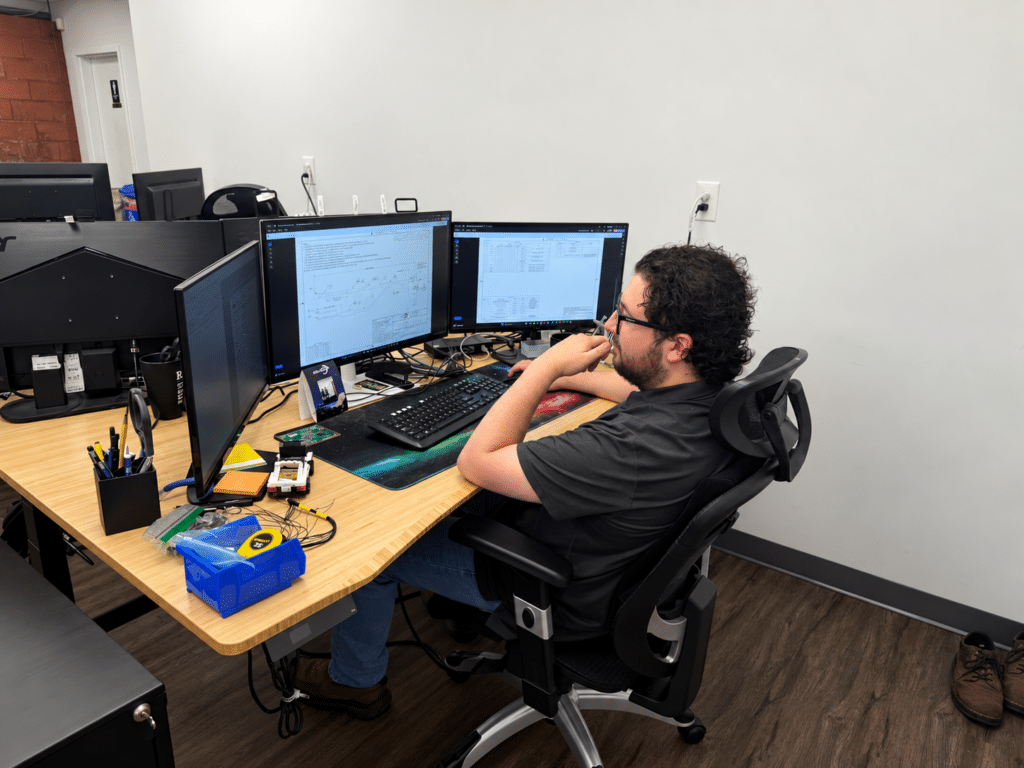
Lite Coms electrical engineer Kyle reviewing technical drawings and engineering documentation at his workstation.

10:00 AM | Balancing Design, Performance and the Real World 

Kyle estimates that roughly 60% of his time is spent on design and analysis and 40% working hands-on with hardware and testing, although that balance can change significantly depending on the stage of a program. 

During the design process, there is much more to consider than whether an individual component will work. Engineers have to evaluate how a potential solution will affect the system as a whole. 

That means balancing factors like size, weight, power, performance, cost, availability, reliability and long-term support. 

Finding the right solution that delivers the best overall SWaP-C—size, weight, power and cost—can require a significant amount of engineering work before a design ever makes it to hardware. 

“I really enjoy having that combination of design work and hands-on testing because I get to see a design go from an idea on paper to an actual working system.” — Kyle 

11:30 AM | Engineering Is a Team Effort 

Systems engineering also means Kyle rarely works in isolation. 

Throughout a program, he collaborates closely with software and mechanical engineering, program management, supply chain and other teams throughout Lite Coms. 

Electrical and software engineers may work together to make sure hardware and software interface correctly, while mechanical engineering helps address packaging, mounting, thermal considerations and physical constraints. Program management brings schedules, priorities and customer expectations into the picture, while supply chain becomes especially important when component selection, availability or obsolescence comes into play. 

Kyle’s role helps connect those individual considerations back to the needs of the overall system. 

“A big part of my job is communicating across those different groups and making sure everyone understands how their piece affects the overall system.” — Kyle 

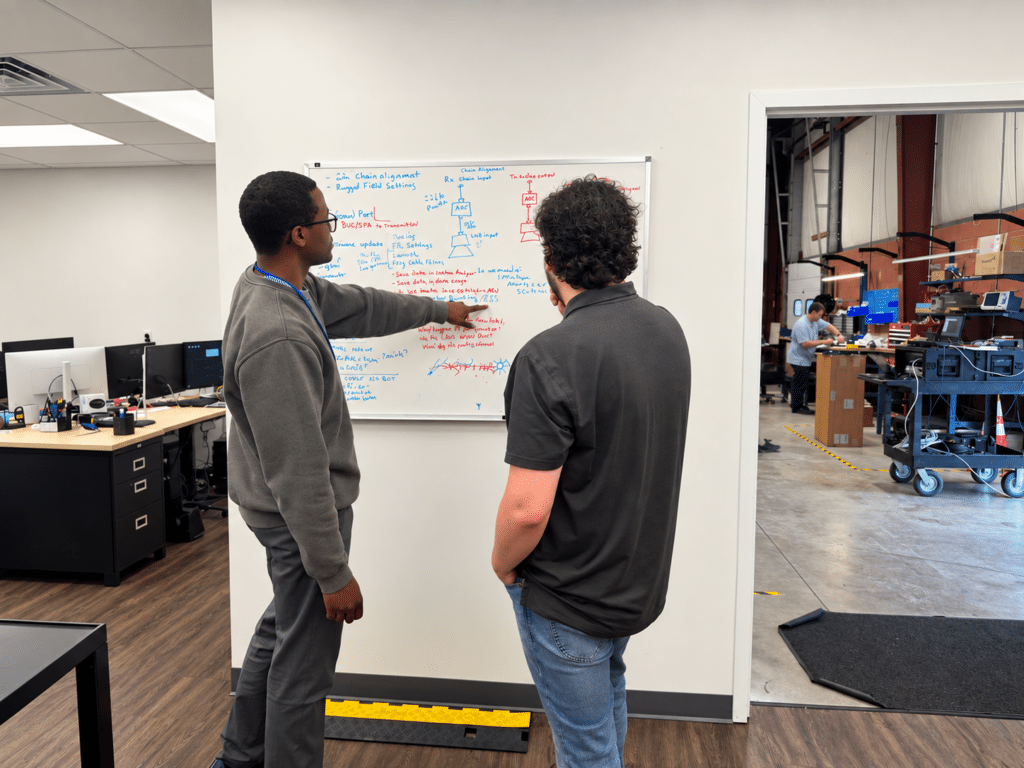
Kyle collaborating with a fellow Lite Coms engineer while reviewing technical diagrams on a whiteboard.

1:00 PM | From the Screen to the Hardware 

Once hardware is available, Kyle’s work can become much more hands-on. 

Depending on the program, he may spend weeks performing validation testing or supporting certifications. That means working directly with hardware, troubleshooting issues, collecting data and analyzing the results. 

The process doesn’t stop when the test is complete. The results need to be reviewed and documented to demonstrate that the system meets its requirements. 

For Kyle, this is where the design work becomes tangible—and where engineers get to see whether the decisions made earlier in the process perform as expected in the real world. 

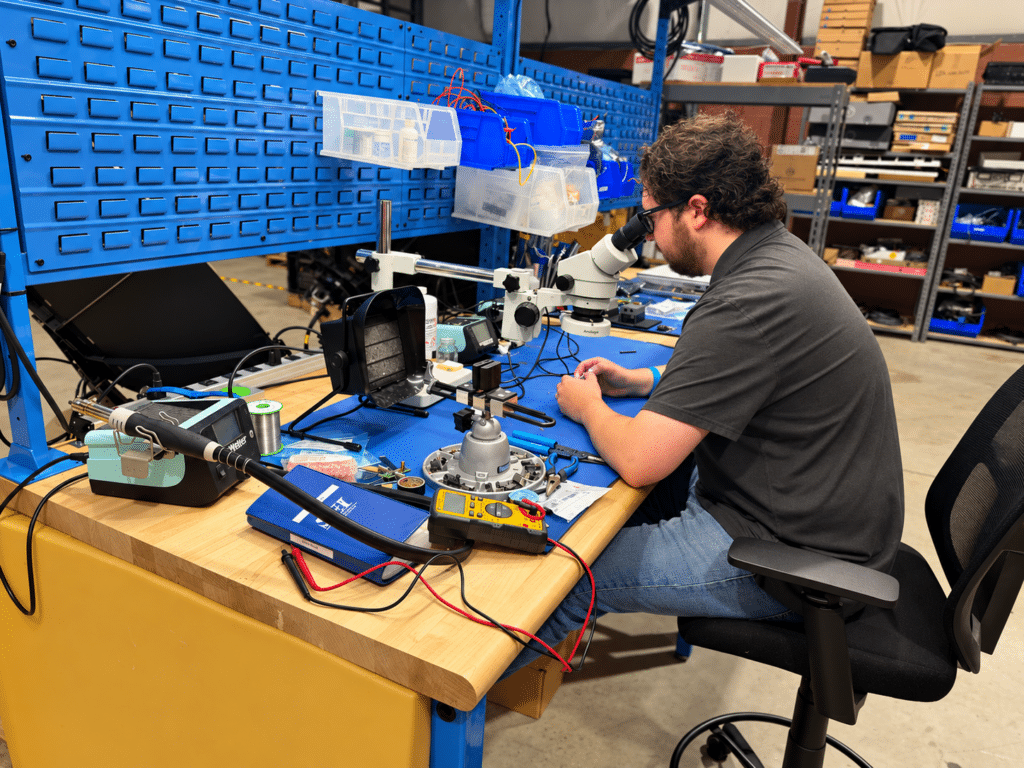
Lite Coms electrical engineer Kyle working hands-on with electronic components under a microscope.

2:30 PM | Solving Problems That Aren’t as Simple as They Look 

Sometimes an engineering challenge begins with something that sounds surprisingly straightforward: replace a part. 

Kyle recently encountered that situation when a component used in an established program was becoming obsolete. 

In a qualified system, however, replacing a component isn’t as simple as finding another part that looks equivalent. 

Kyle first had to understand the system requirements and determine which characteristics a replacement needed to maintain. From there, he worked with the appropriate engineering disciplines and suppliers to identify alternatives and evaluate them against the system’s electrical, mechanical, environmental and performance requirements. 

Once a potential replacement was identified, testing and analysis were needed to validate the change and make sure it didn’t negatively affect the rest of the system. The results and engineering rationale then had to be documented to demonstrate that the updated design continued to meet the required specifications. 

“The problem wasn’t necessarily designing something completely new. It was understanding how one change could affect the entire system.” — Kyle 

It’s a good example of what systems engineering looks like in practice: a change to one component can have implications far beyond that individual part. 

4:00 PM | Making Sure It All Works Together 

By the end of the process, the individual pieces have to come back to one question: Does the complete system perform the way it is supposed to? 

That big-picture perspective runs throughout Kyle’s work, whether he is supporting an established program or helping develop something new. 

On newer programs, his focus shifts more toward system-level performance specifications. He works across engineering disciplines to determine how the system can meet those requirements while balancing performance, size, weight, power, cost, reliability and manufacturability. 

It’s one of the reasons systems engineering plays such an important role. Individual components can perform exactly as intended, but ultimately, they have to work together as one complete system. 

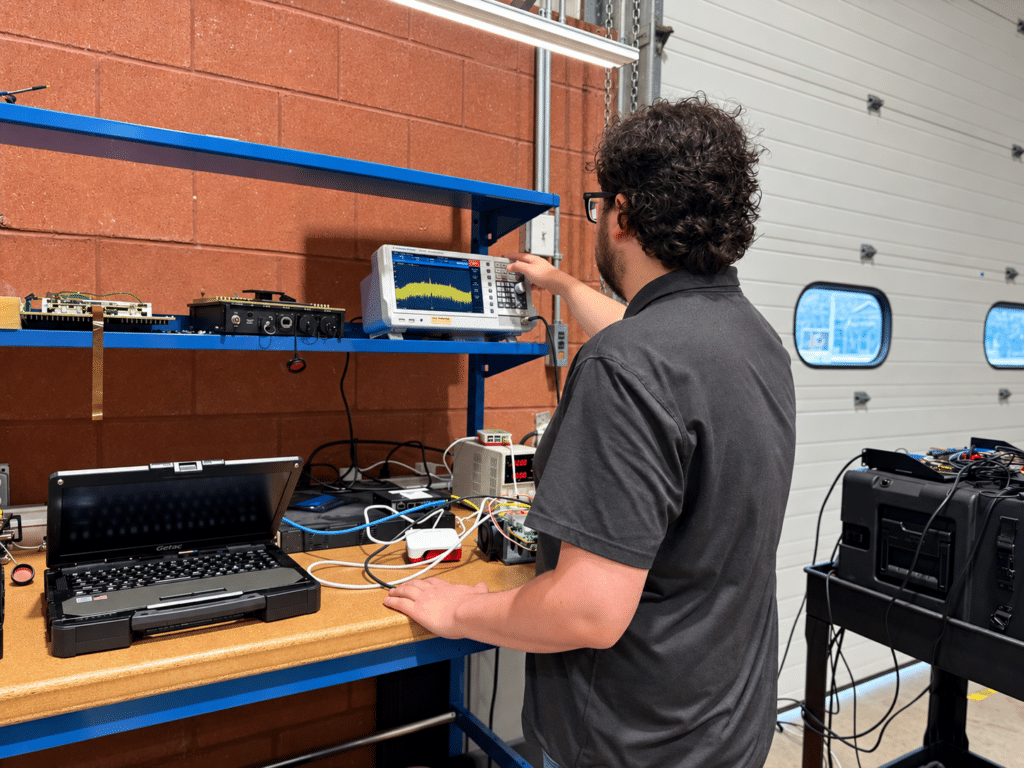
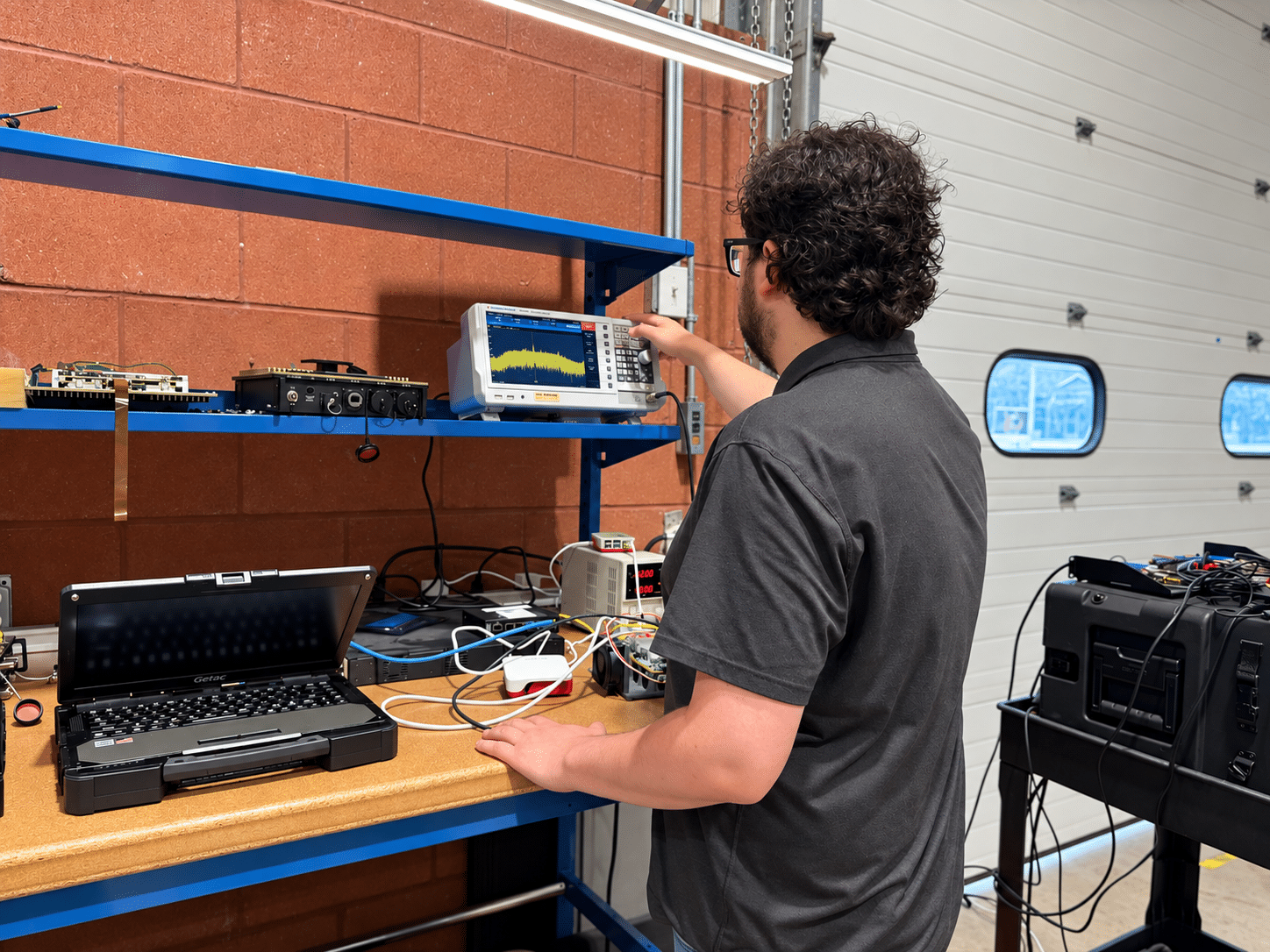
Spectrum analyzer displaying test data during electrical engineering work at Lite Coms.

Kyle’s Advice for Future Engineers 

After spending his career solving engineering problems, Kyle’s advice for engineering students and those just beginning their careers comes down to two things: 

“Be curious and be tenacious.” 

Don’t be afraid to ask questions, Kyle says, especially early in your career. New engineers aren’t expected to know everything, and understanding why something was designed a certain way can often be more valuable than simply learning what was done. 

Tenacity matters just as much. 

Engineering problems don’t always have an obvious answer, and the first solution won’t always work. Being willing to keep digging, learn from the people around you and try a different approach is an important part of becoming a better engineer. 

Kyle also encourages students to seek out hands-on experience whenever possible. 

Classes provide the technical foundation, but projects, labs, internships and opportunities to actually build and test something help bridge the gap between theory and real-world engineering. 

And perhaps most importantly, you don’t need to have your entire career figured out on day one. 

“Focus on building a strong technical foundation, learning from the people around you, and finding the types of problems you enjoy solving.” — Kyle 

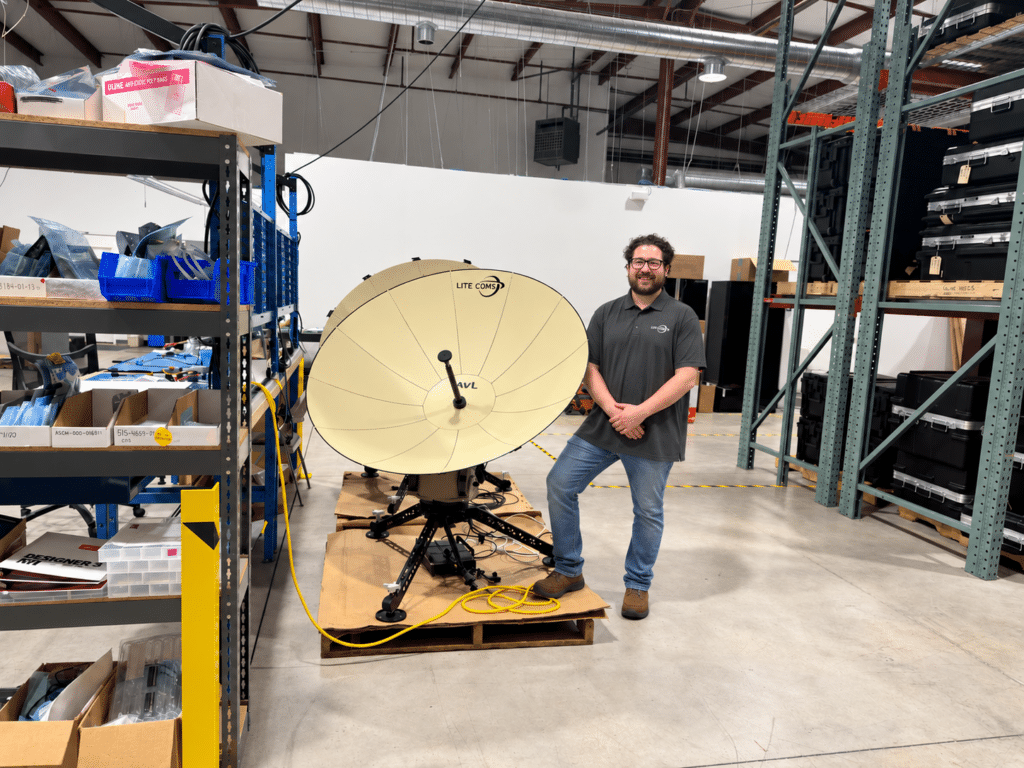
Lite Coms electrical engineer Kyle standing beside a deployable satellite communications terminal.

Engineering at Lite Coms 

From design and analysis to hands-on testing and cross-functional problem solving, Kyle’s day demonstrates how much goes into making sure a complete system performs as intended. 

And sometimes, the most interesting engineering challenges aren’t about designing something entirely new. They’re about understanding how one decision can affect everything around it—and finding the right solution. 

Interested in solving real-world engineering challenges? 

Explore career opportunities at Lite Coms and see where your engineering career could take you. 

Lite Coms and Comtech Terminal-Modem Configuration Achieves Certification for SES Space & Defense’s Sovereign SATCOM Solutions 

Lite Coms has announced that its Lite Sat 1.3A terminal, paired with Comtech’s SLM-5650B modem, is now available as a validated remote-terminal configuration for SES O3b mPOWER Sovereign Services and Hybrid Sovereign Gateway architectures.

The certification provides defense and government customers with a validated path to sovereign MEO connectivity while enabling greater ownership and control of critical communications infrastructure. The pre-engineered configuration also helps reduce integration and program risk, streamline procurement, and provide proven interoperability within the SES ecosystem.

As military users increasingly adopt multi-orbit architectures to strengthen communications resilience and mission assurance, the certified Lite Coms and Comtech configuration provides a rapidly deployable option for secure, high-throughput MEO communications.

Read the full announcement featured by Satellite Evolution Group: https://www.satelliteevolution.com/post/lite-coms-and-comtech-terminal-modem-configuration-achieves-certification-for-ses-space-defense-s

Lite Coms low-SWaP military SATCOM terminals for deployable missions

What low-SWaP means for military SATCOM deployments

SWaP stands for size, weight, and power. A low-SWaP satellite communication terminal is simply one that takes up less volume in a vehicle or aircraft, adds fewer pounds to a team’s load, and draws less current from generators, vehicle alternators, or batteries. For a manpack or two-case terminal, those three numbers decide whether a system moves with the mission or stays behind at the base.

For acquisition teams, the practical question is narrower than a spec sheet: what can a small team carry over distance, power for a full shift in austere conditions, and bring online without tools or a dedicated satellite operator? A laptop-sized flat panel such as the L3Harris DarkWing, listed at 28 lb and setup in under five minutes, shows how far that envelope has moved. Lite Coms’s own LITE SAT 1.3A pushes the flyaway class the same direction: a 1.3-meter auto-acquire antenna that packs into airline-checkable cases and comes up on X-, Ku-, and Ka-band in under ten minutes — the best SWaP figure in the Lite Coms line.

Size, weight, and power also drive second-order effects — setup time, vehicle integration, and how many terminals a unit can field for network resiliency. The sections ahead break down terminal classes, the buying criteria that matter in evaluation, how to map hardware to mission profiles, and the questions worth asking vendors.

Terminal classes: portable, deployable, and tactical options

Procurement teams size terminals by mission duration and lift, not by marketing labels. Three classes cover most requirements.

Portable. The smallest footprint for teams that move on foot or in one vehicle. The LITE SAT 1.2-V is an auto-acquire VSAT built around tool-free setup and a low SWaP profile — size, weight, and power — across X-, Ku-, and Ka-band, suited to short-duration forward tasks where one operator carries and points the system.

Deployable. Flyaway terminals for expeditionary sites and remote command posts — the class where Lite Coms’s low-SWaP engineering shows up most. The LITE SAT 1.3A (AN/TSC-248) packs a 1.3-meter auto-acquire reflector into airline-checkable cases, assembles in under ten minutes, and runs WGS-certified X-, Ku-, and Ka-band service with Viasat GX Type Approval for multi-orbit missions — the best SWaP figure in the Lite Coms line for this class. The larger Lite Sat 2.2A trades that footprint for more aperture: five cases under 112 lb, roughly 15-minute two-person assembly, and ARSTRAT, MIL-STD-810, MIL-STD-1452, and SES O3b certifications.

Tactical. Field-ready, vehicle-integrated systems for mobile operations. L3Harris fields well-established flat-panel options here; the tradeoff is throughput against aperture.

How buyers compare lightweight SATCOM options

Four criteria decide most low-SWaP SATCOM evaluations, and they are best assessed in order.

Footprint and transport burden. Packed dimensions and case count matter more than antenna diameter alone. Ask whether the terminal moves as carry-on, a two-person lift, or a palletized load. L3Harris publishes a useful public benchmark for the flat-panel class: its DarkWing terminal is listed at 28 lb (12.7 kg) in a 17.00 x 11.20 x 3.25 in package.

Power draw. Request continuous and peak consumption at the operating band, then map it against what the mission actually supplies — batteries, a vehicle alternator, or a tactical generator. Terminals requiring external AC or DC supplies add a logistics line item that specification sheets rarely price.

Setup time and crew size. A five-minute figure means little without stating team size and training level. Tool-free assembly and automated acquisition, as on the Lite Coms LITE SAT 1.2-V, shorten the window at the tactical edge.

Ruggedness. Confirm MIL-STD-810 environmental testing and ingress ratings against the deployment climate.

Expect tradeoffs: vehicle-mounted and larger flyaway terminals typically carry heavier multi-band, multi-orbit integration than man-portable systems can support.

How Lite Coms maps to expeditionary, vehicle, and command-post missions

Expeditionary operations. For teams moving on foot or in light vehicles, transport burden and setup time dominate. The LITE SAT 1.3A is Lite Coms’s benchmark here: a 1.3-meter auto-acquire flyaway that packs into airline-checkable cases, assembles in under ten minutes without tools, and runs WGS-certified X-, Ku-, and Ka-band service — the profile that matters when a link has to come up before a position is consolidated. Where footprint has to shrink further, the LITE SAT 1.2-V covers the smallest one-operator loadout with the same tool-free, auto-acquire design.

Vehicle-mounted use. Here the questions shift to mounting interfaces, DC power draw, and whether the terminal can be stowed and re-deployed repeatedly without recalibration. Automated acquisition reduces operator training load; procurement teams should still validate power budget and platform integration against the specific vehicle. AvL has a longer public track record in vehicle-mount configurations and MIL-810 qualification breadth, and that history is worth weighing.

Remote command posts. Multi-band, constellation-agnostic operation supports network resiliency when one space segment degrades, and a compact terminal can be repositioned as the post moves. The LITE SAT 1.3A’s Viasat GX Type Approval and mPOWER compatibility give a command post a validated path across multiple network operators as the mission shifts orbits or providers.

The tradeoff is straightforward: low-SWaP SATCOM buys mobility, not capacity. When a program needs sustained high throughput or deep integration into a fixed architecture, a larger flyaway or fixed terminal remains the correct choice.

What the field data says about compact military terminals

Published specifications are the only honest starting point. L3Harris lists its DarkWing flat-panel terminal at 28 lb (12.7 kg) in a 17.00 x 11.20 x 3.25 in package, with setup in under five minutes on Inmarsat GX Ka-band — a useful reference point for what a laptop-sized terminal weighs and how fast it acquires. AvL publishes a different tradeoff: vehicle-mounted and quick-deploy flyaway configurations, multi-band and multi-orbit operation, WGS support in X- and Ka-bands, and MIL-810 certification across most of its line — deeper qualification breadth than most compact terminals carry. Kymeta’s material centers on multi-orbit, multi-network connectivity integrated into vehicles and vessels. Intellian’s compact maritime systems make the logistics argument: less weight and single-cable installation cut freight and install labor.

Lite Coms’s own line shows that tradeoff inside one brand: the LITE SAT 1.2-V covers the smallest man-portable footprint in the auto-acquire, multi-band X/Ku/Ka class with tool-free setup, while the LITE SAT 1.3A delivers the best SWaP figure in the deployable class — a 1.3-meter auto-acquire reflector in airline-checkable cases, sub-ten-minute assembly, WGS certification, and Viasat GX Type Approval. Buyers weighing Viasat, Gilat, or Get SAT manpack options should request current weight, power draw, and waveform certifications in writing — vendor datasheets vary in what they disclose.

FAQ: smallest, lightest, and lowest-SWaP military SATCOM terminals

What does “smallest and lightest” actually mean in a spec sheet? Three numbers together: pack-up dimensions, single-person carry weight, and draw at the connector. A flat-panel terminal like the L3Harris DarkWing is published at 28 lb (12.7 kg) and 17.00 x 11.20 x 3.25 in, running on external AC or DC power — useful reference points for what one operator can move and feed.

Is a manpack, vehicle-mounted, or flyaway terminal the better fit? Match it to the deployment method. Manpack and ultra-portable terminals suit dismounted teams on battery or vehicle power. Vehicle-mounted systems earn their weight when communications on the move matter. Flyaway terminals, including larger multi-band reflectors, deliver throughput a panel cannot — the Lite Coms LITE SAT 1.3A is a case in point, packing a 1.3-meter WGS-certified reflector into airline-checkable cases for expeditionary and command-post use.

Does low-SWaP cost you bands or orbits? Not automatically. Multi-band X/Ku/Ka coverage and auto-acquire pointing exist in compact form factors — verify certifications (MIL-STD, WGS, operator qualification) against your program requirements, not the brochure.

Review the LITE SAT 1.2-V and LITE SAT 1.3A specifications against your mission profile.

Everything You Need to Know About the iDirect 950mp End-of-Life Transition

If your organization operates Lite Sat™ TMAs embedded with the iDirect Government 950mp modem family, now is the time to begin planning for the future.

iDirect Government has officially announced the End-of-Life (EOL) of the 950mp product family. While existing systems are expected to remain supported through the published technical support period, the final opportunity to procure new 950mp hardware is approaching. Planning ahead can help minimize risk, maintain operational readiness, and ensure a smooth transition.

Important: If your organization anticipates needing spare or replacement iDirect 950 TMAs, Lite Coms recommends submitting those requirements by September 18, 2026. This provides additional time to coordinate your needs ahead of iDirect Government’s final procurement date of September 30, 2026.

Important Lifecycle Dates

Milestone Date
Lite Coms Recommended Date to Request Spares & Replacements September 18, 2026
iDirect Final Procurement Date September 30, 2026
iDirect Final Scheduled Shipments* July 31, 2027
iDirect Planned End of Technical Support** December 31, 2030

* Subject to manufacturing schedules and product availability.

** Per applicable contractual support agreements.

What Is Replacing the 950mp?

iDirect Government has identified the 450 Family as the recommended replacement platform for the 950mp.

The 450 Family introduces several advancements, including:

  • Software-defined architecture
  • Multi-waveform capability
  • Multi-constellation operation
  • Increased processing capacity and throughput
  • Enhanced cybersecurity capabilities
  • Continued long-term product investment and roadmap support

Lite Coms currently offers the Lite Sat 450 TMA, an embedded solution built around the iDirect 450 platform and available for shipment today.

What Should Customers Be Doing Now?

Lite Coms encourages planning, support, and sparing 950 TMAs as soon as possible. 

Recommended planning activities include:

  • Forecasting future hardware requirements
  • Completing procurement before the final procurement deadline
  • Reviewing current 950mp deployments
  • Developing migration plans
  • Coordinating transition planning with your account representative

Early planning provides time to complete engineering changes, budget approvals, contract modifications, operational testing, certification activities, and deployment scheduling while maintaining mission continuity.

Lite Coms Is Here to Help

As a long-time integration partner, Lite Coms is working closely with iDirect throughout this transition.

We recognize that additional migration guidance and compatibility information will continue to become available over the coming months. Our team is committed to helping customers understand their options, develop transition strategies, and ensure continued mission readiness.

Our team can assist with:

  • Reviewing existing Lite Sat TMA deployments
  • Discussing migration strategies
  • Planning future spare inventory
  • Evaluating replacement timelines
  • Providing quotations for Lite Sat 450 TMAs
  • Answering technical questions throughout the transition

As additional guidance becomes available from iDirect Government, Lite Coms will continue sharing updates to help customers make informed decisions.

If you have questions about your existing Lite Sat TMAs, would like to discuss spare inventory planning, or are ready to begin transitioning to the Lite Sat 450 TMA, we’re here to help.

Contact Lite Coms today to discuss the best transition strategy for your program.

Rochester Business Journal Highlights Lite Coms’ Leadership and Continued Growth

The Rochester Business Journal recently featured Lite Coms’ appointment of Greg Campbell as President and the company’s continued growth in Victor, New York.

Campbell officially assumed the role on June 30, 2026, and now oversees Lite Coms’ day-to-day operations. Founder Bob Jacobson remains Chief Executive Officer and will focus on sales, major programs, strategic initiatives, and new market opportunities.

The article also highlights Lite Coms’ rapid expansion since the company was founded in 2019. After outgrowing its original location, Lite Coms relocated to Victor and continued investing in the people, facilities, and manufacturing capabilities needed to support increasing demand for its tactical satellite communications systems.

Most recently, Lite Coms completed a $2.8 million expansion at its Victor headquarters, adding a 20,000-square-foot production facility. The expanded campus has increased manufacturing capacity and supports the company’s growing defense, government, and commercial customer base.

With Campbell leading daily operations and Jacobson focused on long-term growth, Lite Coms is positioned to continue expanding its capabilities while maintaining its commitment to solving complex customer challenges and delivering reliable SATCOM solutions.

Read the full Rochester Business Journal article to learn more about Lite Coms’ leadership transition, manufacturing expansion, and continued growth.

Lite Coms Appoints Greg Campbell as President

Lite Coms has announced the appointment of Greg Campbell as President, effective June 30, 2026. The leadership transition supports the company’s continued growth and strengthens its ability to serve defense and government customers with innovative tactical SATCOM solutions.

Campbell brings decades of leadership experience in the aerospace and defense industries. Prior to joining Lite Coms, he served as President of Calspan, where he led strategic growth initiatives and supported advanced aerospace and satellite communications programs. His background includes overseeing complex technology organizations and driving innovation in support of critical government missions.

As President, Campbell will lead Lite Coms’ day-to-day operations, with a focus on expanding manufacturing capabilities, investing in new technologies, and continuing to deliver reliable communications solutions for customers operating in demanding environments worldwide.

Founder Bob Jacobson will remain Chief Executive Officer, concentrating on strategic growth initiatives, new market opportunities, major programs, and customer relationships. Together, Campbell and Jacobson will guide Lite Coms through its next phase of growth while maintaining the company’s commitment to innovation, quality, and customer success.

This leadership transition reflects Lite Coms’ long-term investment in its people, technology, and mission of providing dependable tactical satellite communications solutions for military and government organizations.

Read the full announcement to learn more about Greg Campbell’s appointment and Lite Coms’ vision for the future.

Lite Coms Awarded $22 Million Contract to Support Critical SATCOM Requirements

Lite Coms has been awarded a $22 million contract to deliver advanced tactical satellite communications (SATCOM) capabilities supporting mission-critical communications for a U.S. government customer.

The award reflects continued confidence in Lite Coms’ ability to provide secure, resilient, and rapidly deployable communications solutions for defense and government operations. As mission requirements continue to evolve, reliable connectivity remains essential to maintaining operational readiness in challenging environments.

Lite Coms designs, manufactures, and integrates tactical communications systems that enable dependable communications across a wide range of operational scenarios. Its portfolio includes deployable SATCOM terminals, mobile communications systems, and integrated solutions built to support customers operating in demanding conditions around the world.

This contract further reinforces Lite Coms’ commitment to engineering innovation, manufacturing excellence, and delivering mission-ready communications solutions that help government and defense organizations stay connected when it matters most.

The award also highlights the company’s ongoing investment in expanding its capabilities while working closely with customers and industry partners to meet evolving operational needs.

To learn more about the contract award and what it means for Lite Coms and its customers, read the full press release below.

Read the full press release: https://www.prnewswire.com/news-releases/lite-coms-awarded-22-million-contract-to-support-critical-satcom-requirements-302806441.html

 Auto-Acquire Satellite Terminals for On-the-Move Operations

Key Takeaways

1. Essential for Remote Operations: Auto-acquire satellite terminals are crucial for maintaining reliable communication in remote military operations. They ensure uninterrupted command and control, enhancing mission success in challenging environments.
2. Field-Tested Solutions from Lite Coms: Lite Coms provides robust, compliant solutions that integrate seamlessly with existing military networks. Their satellite terminals are designed to function in extreme conditions, meeting stringent NSA, FIPS, and ITAR standards.
3. Addressing Procurement Challenges: Understanding military procurement challenges like budget constraints and lengthy cycles is key. Lite Coms offers streamlined processes, including pre-positioned RFP responses and phased evaluation programs, to accelerate decision-making and deployment.

By focusing on these key areas, military officers can ensure effective communication capabilities that are vital for remote and austere operations, aligning with both operational and regulatory requirements.

In the rapidly evolving landscape of 2026, maintaining effective communication is a cornerstone of successful military operations, especially when operating in remote and challenging terrains. As a military officer, you are well aware of the critical importance of reliable communication systems that can withstand the demands of austere environments. Auto-acquire satellite terminals have emerged as indispensable tools for ensuring seamless connectivity in such scenarios, enabling you to maintain command and control over your operations.

Lite Coms, a leader in military satellite communication solutions, is at the forefront of providing cutting-edge technology designed to meet the rigorous demands of military communication, logistics, and acquisition roles. Our solutions are not just technologically advanced but are also field-tested to ensure compliance with stringent military standards and seamless integration with existing networks. In this article, we’ll explore how Lite Coms’ offerings can address the unique challenges you face in ensuring reliable communication, comply with necessary regulations, streamline procurement processes, and support long-term operational needs.

1. The Importance of Reliable Communication in Remote Operations

In 2026, as a military officer, ensuring reliable communication in remote operations is critical for maintaining command and control. The challenges faced in austere environments—where traditional infrastructure is often nonexistent or compromised—demand robust solutions. These environments require systems that can withstand extreme weather and terrain, ensuring mission-critical communication remains uninterrupted.

Lite Coms addresses these challenges with its advanced satellite terminals, designed specifically for the rigors of military applications. These terminals are engineered to provide consistent connectivity even in the harshest conditions, supporting your mission needs effectively. By incorporating Lite Coms’ solutions, you can enhance operational capabilities, ensuring seamless communication for forward-deployed personnel, ultimately contributing to mission success.

2. Compliance and Interoperability: Meeting Military Standards

Adhering to established military standards is paramount for ensuring the efficacy and security of satellite communication systems. In 2026, compliance with NSA, FIPS, and ITAR standards is non-negotiable for all military communications equipment. These regulations safeguard sensitive information and ensure that communication systems meet stringent security and operational requirements.

Seamless integration with existing Command and Control (C2) networks and allied equipment is crucial. Systems must not only comply with technical specifications but also be compatible with legacy systems and allied networks, ensuring operational readiness and collaborative defense efforts.

Lite Coms stands out by consistently demonstrating its compliance credentials and proven interoperability. With NSA certifications, FIPS compliance, and adherence to ITAR regulations, Lite Coms’ solutions are engineered to integrate smoothly into current military frameworks, providing reliable and secure communication channels essential for mission success.

3. Overcoming Procurement Challenges

Navigating the complexities of military procurement in 2026 requires a strategic approach to tackle budget constraints and lengthy acquisition cycles. As military officers responsible for satellite communication systems, you’re well aware of the impact that fiscal limitations and extended procurement timelines can have on decision-making. These factors necessitate a careful balance between mission-critical needs and financial prudence.

To streamline the procurement process, consider adopting phased evaluation and pilot programs. These strategies allow for gradual integration, minimizing risks and facilitating smoother transitions. Lite Coms is committed to supporting this approach by providing comprehensive documentation and pre-positioned RFP responses. Our goal is to simplify the acquisition journey, ensuring that you have the tools and support needed to make informed decisions efficiently.

4. Ensuring Long-Term Support and Reliability

In the current military landscape, the sustainability of satellite communication systems is paramount for mission success. Lifecycle management over a 10-15 year deployment presents unique challenges. It’s crucial to address concerns about long-term maintenance, support, and spare parts availability. Lite Coms recognizes these challenges and offers robust lifecycle support solutions that ensure operational continuity.

Vendor stability is another critical factor. Military officers need assurance that their technology partners will remain reliable over extended periods. Lite Coms is committed to fostering long-term partnerships, underpinned by comprehensive training programs and a strong spare parts strategy. This dedication alleviates fears about vendor continuity, ensuring that your operations are never compromised by supply chain disruptions.

By choosing Lite Coms, you’re investing in a partner that prioritizes your strategic needs, providing not only advanced technology but also the enduring support needed for sustained mission effectiveness.

5. Case Studies: Proven Performance in the Field

Lite Coms continues to demonstrate the versatility of its SATCOM solutions across a variety of operational environments. During a Marine Reserve training exercise near Fort Greely, Alaska, the LITE SAT 1.3A was utilized in a Highly Elliptical Orbit (HEO) configuration to support communications in a challenging high-latitude environment where traditional GEO coverage can be limited.

More recently, the Lite Coms Hurricane supported a demonstration of the Riverine Assault Support System (RASS) at Camp Lejeune. Operating on the water, the Hurricane provided reliable, high-throughput backhaul in an environment where mobility, size, weight, and rugged performance are critical.

These demonstrations highlight the adaptability of Lite Coms solutions across diverse mission sets and reinforce their ability to support reliable communications in demanding operational environments.

Conclusion

In 2026, the dynamic landscape of military operations demands robust and reliable satellite communication systems, particularly for remote and austere environments. Lite Coms’ auto-acquire satellite terminals present a compelling solution, combining field-tested reliability with full compliance to military standards. For military officers managing communications, logistics, and acquisition roles, these systems are indispensable for maintaining seamless command and control. By partnering with Lite Coms, you can ensure your operations are equipped with cutting-edge technology that meets stringent interoperability and security requirements. Explore Lite Coms’ offerings to enhance your operational readiness and achieve mission success in the most challenging environments.

FAQ

1. What makes Lite Coms’ satellite terminals suitable for military use?
Lite Coms’ terminals are designed to meet stringent military standards, ensuring compliance with NSA, FIPS, and ITAR requirements, and offer seamless integration with existing networks.

2. How does Lite Coms address long-term support concerns?
Lite Coms provides comprehensive lifecycle support, including spare parts availability, training programs, and vendor stability assurances to ensure long-term operational reliability.

3. Can Lite Coms’ solutions handle extreme environmental conditions?
Yes, Lite Coms’ satellite terminals are engineered for robust performance in austere environments, ensuring reliable communication in challenging terrains and weather conditions.

4. Are there any real-world examples of Lite Coms’ terminals in action?
Lite Coms has numerous case studies showcasing the successful deployment of their terminals in various military operations, demonstrating their effectiveness and reliability in the field.