
What a 1.3 Meter Deployable VSAT Terminal Is for Military Use
A 1.3 meter deployable VSAT terminal is a transportable satellite communication system built around a roughly 1.3 m reflector — usually segmented carbon fiber — that packs into cases, travels with the unit, and is assembled on site rather than installed on a permanent pad. The aperture sits in the sweet spot of the 1–1.5 meter VSAT terminals class: large enough for sustained X-, Ku-, or Ka-band throughput on networks such as Wideband Global SATCOM, small enough to move by vehicle, rotary wing, or airline baggage hold.
The users are forward-deployed units, mobile command posts, signal detachments standing up a tactical edge node, and emergency response teams operating where terrestrial infrastructure is gone.
The engineering tension is constant: every increase in antenna size buys link margin but costs weight, stow volume, and setup time. That is why acquisition teams shopping for lightweight auto-acquire terminals built for rapid field deployment weigh four things — field readiness, time from case to carrier lock, network and band compatibility, and transportability.
The sections ahead apply that lens to deployable terminals in the 1–1.5 m range, not fixed-site earth stations.
Lite Coms LITE SAT 1.3A: Capabilities That Matter in the Field
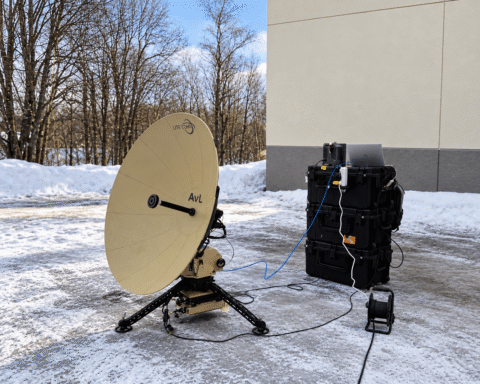
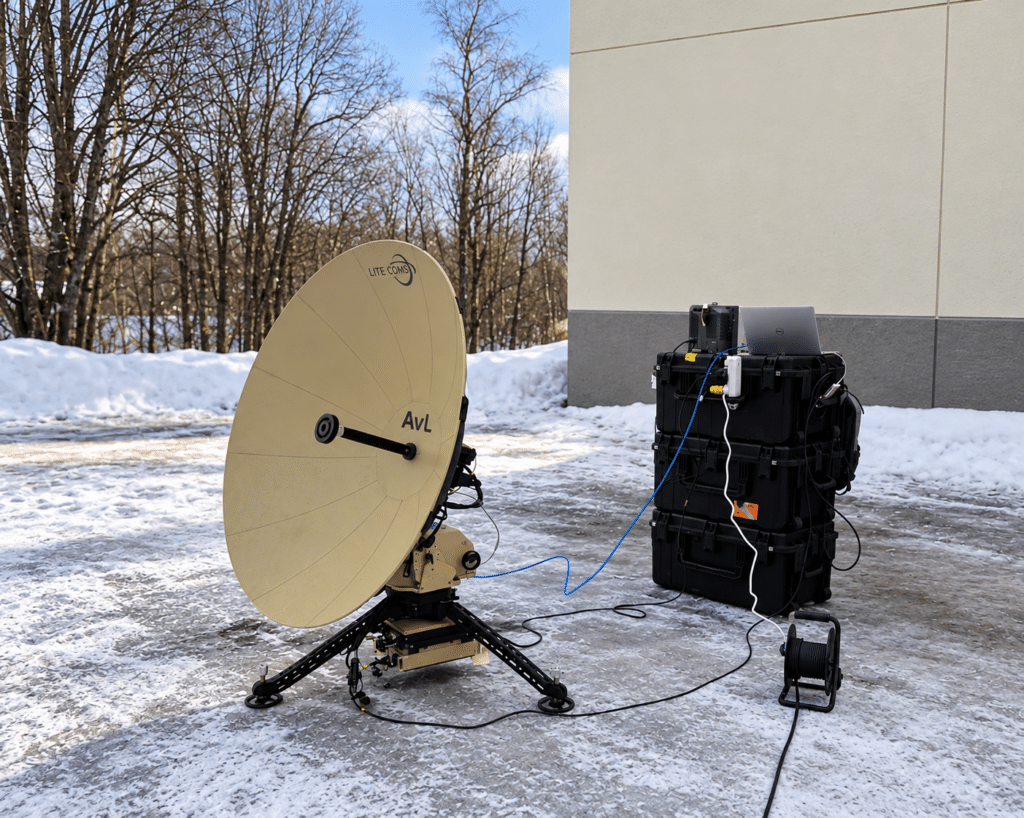
Within the 1–1.5 meter VSAT terminals class, the LITE SAT 1.3A (AN/TSC-248) is a 1.3-meter auto-acquire flyaway built for expeditionary and military operations. Lite Coms’s product documentation lists it as WGS-certified, designed and manufactured in the USA, and operable across X-, Ku-, and Ka-band networks — one terminal covering military wideband and commercial capacity without swapping airframes, plus stated compatibility with newer architectures including O3b mPOWER.
The deployment math is what changes behavior on the ground. The published specification puts the system under 100 lbs and airline-checkable, so a two-person element can move it as checked baggage rather than scheduling airlift. Setup is tool-free, and automated satellite acquisition brings the link up in minutes, which removes the pointing skill requirement that usually dictates who can deploy a terminal at all.
For acquisition teams weighing lightweight auto-acquire tactical terminals, that combination translates into fewer trained operators per node, shorter time-to-first-byte, and more predictable setup timelines across dispersed sites.
Mission Fit for Remote Operations, Rapid Setup, and Secure Connectivity
In austere locations, the limiting factor is rarely throughput — it is how much lift, power, and trained manpower a team can bring. That is why 1–1.5 meter VSAT terminals keep winning expeditionary requirements: enough aperture for wideband links, small enough for a two-person crew. Lite Coms states that the LITE SAT 1.3A packs airline-checkable at under 100 lbs and sets up tool-free with automated acquisition, so a detachment can establish a link without a ground support package.
Rapid setup is a timing problem. Mobile command posts displace on short cycles, and satellite windows close. Terminals that acquire automatically compress the gap between arrival and first traffic — a criterion where L3Harris advertises sub-five-minute setup for its flat-panel DarkWing, a lighter, lower-aperture option worth evaluating alongside parabolic systems.
Secure connectivity belongs in the specification, not the brochure. WGS certification and X-, Ku-, and Ka-band operation let a unit shift between military and commercial networks as it crosses operating areas — the practical basis of network resiliency when one path degrades.
How Buyers Compare 1–1.5 Meter Tactical VSAT Terminals
Four criteria separate the options when evaluating 1–1.5 meter VSAT terminals for a program of record.
Size. A 1.3 m aperture sits between laptop-sized man-portable units and fielded trailer or vehicle platforms. It buys link margin and multi-band reach without the lift requirements of larger systems.
Acquisition speed. Automated pointing is the training-burden lever. L3Harris publishes setup in under five minutes for its 28 lb DarkWing flat panel, and AvL cites one-button auto-acquire on its vehicle-mount antennas. Lite Coms documentation describes tool-free setup and automated satellite acquisition on the LITE SAT 1.3A, with connectivity in minutes.
Mobility. Airline-checkable cases, sub-100 lb system weight, and two-person handling determine whether a terminal actually moves with the team. Flat-panel terminals win outright on raw portability — a carry-on-sized unit stages faster than any segmented reflector.
Ruggedness. Transit-case survivability, carbon fiber reflector construction, and operation in austere heat and dust matter more than catalog weight.
The tradeoff is direct: compact panels are lighter; a 1.3 m terminal with X-, Ku-, and Ka-band support and WGS certification fits wideband military network plans.
How 1.3 Meter Deployable Terminals Compare with Nearby Tactical Options
Within the 1–1.5 meter VSAT terminal class, aperture is only one variable. L3Harris publishes DarkWing at 28 lb / 12.7 kg with setup in under five minutes on Inmarsat GX Ka-band — genuinely lighter and faster to stand up than any parabolic system, and the better fit for small teams moving on foot or by air with carry-on limits. AvL describes tool-free flyaway assembly and one-button auto-acquire on its vehicle-mount antennas, which suits convoy and on-the-pause operations.
Lite Coms’s documentation positions the LITE SAT 1.3A differently: under 100 lbs, airline-checkable, WGS-certified, with X-, Ku-, and Ka-band support in one package. That is not as compact as a flat panel, and procurement teams should say so plainly. The tradeoff buys military network fit and multi-band reach that smaller apertures do not cover.
Match the terminal to the mission profile — transport method, required networks, and operator workload rarely point to the same answer.
FAQ: Available 1.3 Meter and 1 to 1.5 Meter Tactical Terminals
What defines a 1.3 meter terminal? Reflector diameter, not case dimensions. Across 1–1.5 meter VSAT terminals, a 1.2 m aperture saves pack volume, 1.5 m buys link margin at added weight, and 1.3 m sits between — gain for C5ISR traffic in a package that still checks as airline baggage. Fielded examples in this aperture band include the Lite Coms LITE SAT 1.3A, the L3Harris Hawkeye 4 Lite 1.3M flyaway, and AvL’s 1.2 m tri-band motorized tripod flyaway.
What should procurement verify? Ask for WGS certification documentation and the specific bands supported — X, Ku, Ka. Lite Coms lists all three for the LITE SAT 1.3A, under 100 lbs, with tool-free setup and automated acquisition.
What about setup? Request measured time-to-link, case count, and operator training burden. For lightweight auto-acquire terminals built for rapid field deployment, flat panels like DarkWing pack smaller at 28 lbs, though parabolic apertures carry more throughput headroom. Match aperture to mission profile, network access, and transport limits.
For expeditionary military operations, Lite Coms offers a practical 1.3 meter deployable VSAT option to evaluate.